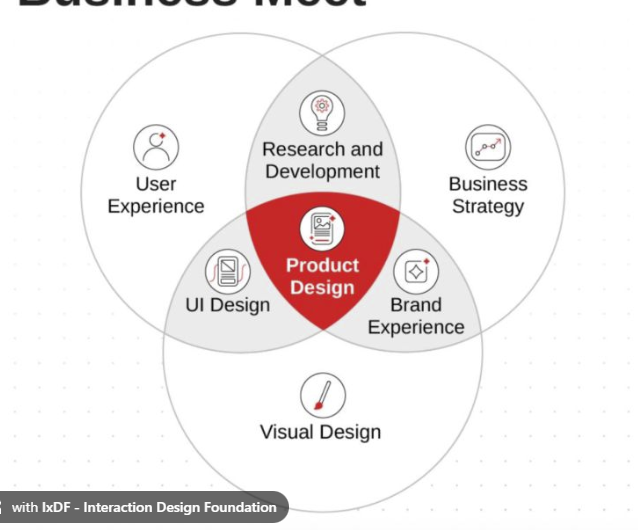
I saw this image in social media, and immediately my thumb and index finger began to twiddle my chin.
I’d say, it’s *mostly* right.
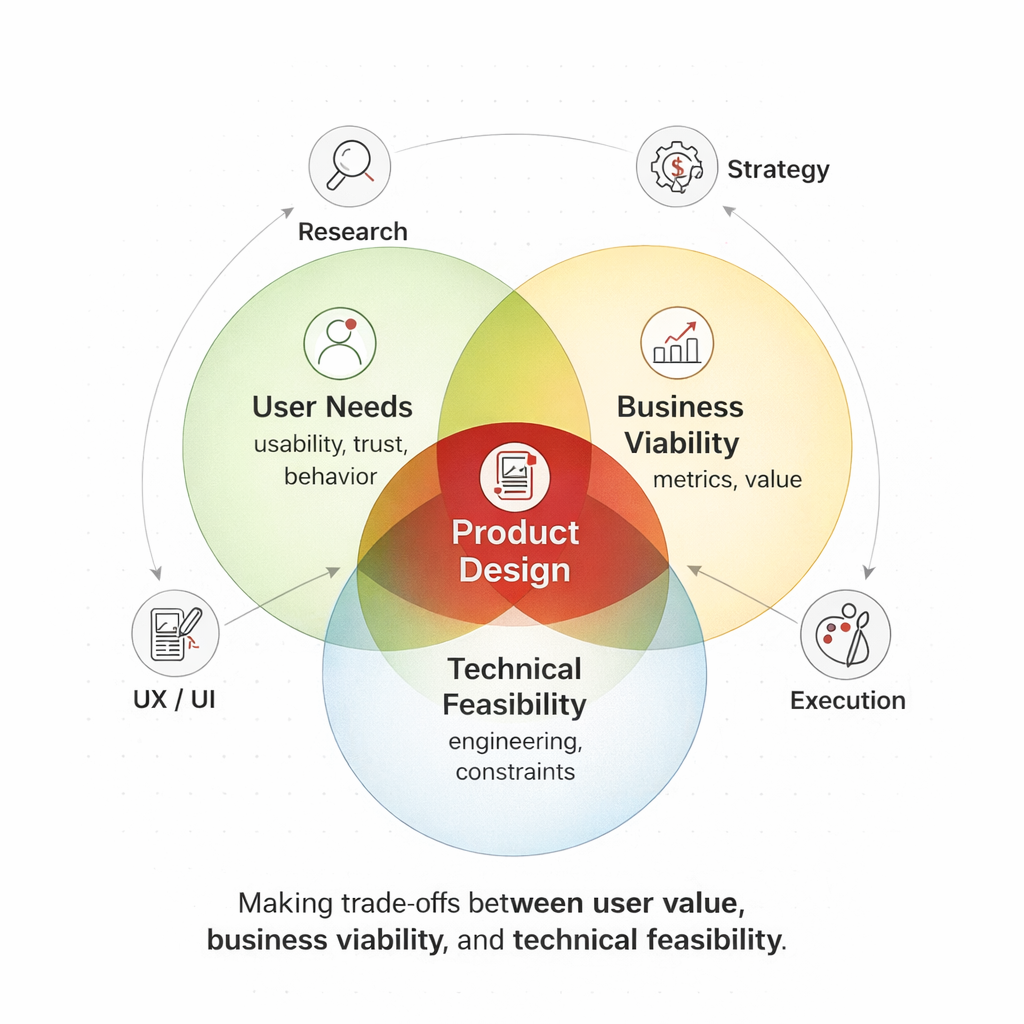
Product Design is where user experience, visual clarity, and business reality are negotiated into something that actually ships.
That’s how I’d like to put it. Same idea. More honest about the responsibility. The original idea isn’t wrong, it’s just *polite*. Product Design, in practice, is less a meeting and more a constant argument that someone has to win responsibly.
- User Experience Designers ask: Is this usable, understandable, accessible, and humane?
This includes interaction design, information architecture, content, accessibility, and visual design as a core mechanism for perception and comprehension. - The Business asks: Is this viable, scalable, defensible, and worth sustaining?
- Engineering asks: Can this be built, maintained, and evolved within real constraints?
- and finally, Product Design asks: What should exist, why it should exist, and how to deliberately balance user experience, business viability, and technical feasibility in a system that actually ships.
So Product Design isn’t just where those things meet. It’s where UX (inclusive of visual design) is weighed against business and technical realities, and where trade-offs are made with intent rather than by accident.
A UX designer can still optimize flows, structure, and clarity without owning business constraints. A visual designer can still specialize in execution within UX without setting strategy. A business stakeholder can still define goals without understanding user friction.
A product designer, however, sits at the point of accountability and decides what not to build, where usability bends to feasibility, where business goals must yield to user trust, and how UX (including visual clarity) carries product intent into reality.
So, the diagram isn’t quite accurate any more.
Here’s a new diagram, the way I’d like to put it:
Another thing.
“Visual Design” isn’t its own thing. It Belongs to UX
Visual design is not a separate discipline from user experience; it is one of the primary ways UX is perceived, understood, and trusted. UX is concerned with how a product feels to use, how clearly it communicates, how easily it can be understood, and how confidently a user can act within it. Visual design directly shapes those outcomes through hierarchy, contrast, typography, colour, and motion. When users miss an important action, feel uncertain about what is clickable, or lose trust in a product’s credibility, the failure is experiential, even if it presents visually.
User Experience Design
│
├── Research & Insight
├── Information Architecture
├── Interaction Design
├── Content & Language
├── Accessibility
└── Visual Design <=======
    ├── Hierarchy
    ├── Colour
    ├── Typography
    ├── Motion
    └── Brand expression
The idea that visual design sits outside of UX largely comes from organizational convenience rather than conceptual truth. Teams often split “UX” and “visual” roles for hiring or workflow reasons, which led to diagrams that frame them as parallel disciplines. In practice, visual design is one of UX’s core mechanisms for guiding attention, supporting cognition, expressing brand tone, and ensuring accessibility. UX may define intent and structure, but visual design is how that intent becomes legible to human perception. Without it, UX remains theoretical; with it, experience becomes real.